The Memorabilia Trap: When Rarity Replaces Meaning
Film memorabilia can become a record of your viewing habits, not just a hunt for scarce editions. Learn how to choose, document, and store keepsakes with care.
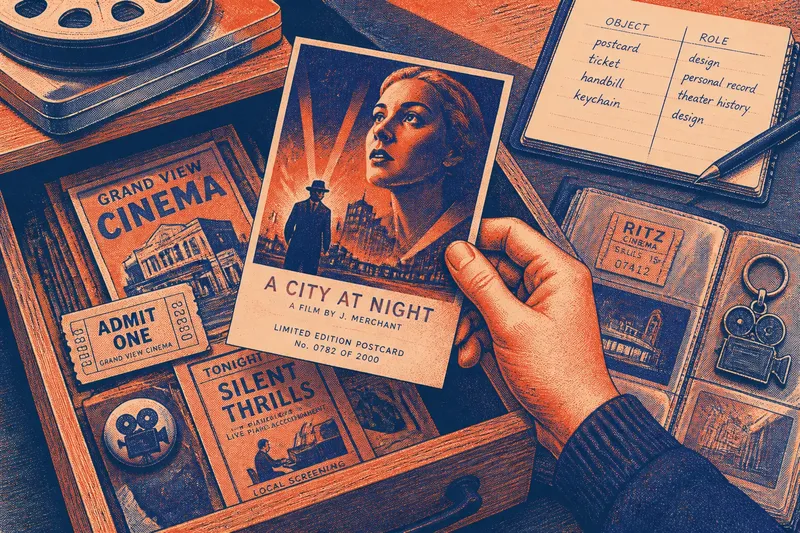
A glossy cinema postcard slips from a drawer after a move. You recognize the film, but not the postcard. Its print-run note is clear; the evening it supposedly represents is not. Film memorabilia can be valuable as an artifact, a decoration, or a personal record. Those are different reasons to keep it.
The useful question is not whether an object is rare. It is what role you want it to play. A ticket stub might document a theater’s old admission design, suit a frame on your wall, or mark a night you shared with someone. None of those uses needs to impersonate another.
Scarcity describes an object, not its purpose
A limited edition can be hard to find, but scarcity alone says little about whether you want to own it. An original handbill may interest you for its printing and local distribution. A mass-produced keychain may please you because you like the design. A ticket may matter because it is the only physical record of a particular outing.
Separate the object’s appeal from its role in your collection. Ask what you know about its origin, what you enjoy about its appearance, and whether you want it to document an occasion. These answers can overlap, but they do not have to.
Before buying, write one sentence about why you want the item. “I like the artwork” is a complete reason. “It is rare, so it must belong here” is a reason that may keep moving the goalposts.
Build a collection around a clear purpose
A collection can focus on personal screenings, theater history, film design, or a particular kind of object. Trouble begins when those purposes blur and every purchase is expected to satisfy all of them. A scarce poster can be a good design object without being a record of your own moviegoing.
Say you are deciding whether to buy a locally printed handbill. You know its venue and film title, and you like its typography, but it has no connection to a screening you attended. If your collection is about cinema design, the handbill fits; if you are keeping objects to document your own outings, it does not. The result is a clear choice: buy it for the design, or leave it for a collection with a different purpose.
When a collection grows, sort a small group by role: personal records, objects kept for design or history, and items whose main appeal is scarcity. Then decide whether each role still belongs in your collection. A beautiful object does not need a sentimental backstory to earn its place.
Keep claims about origin separate from personal meaning
Terms such as “staff issue” or “from an early screening” describe claims about an item’s history. Check what supports them rather than treating a listing’s wording as established fact. A printed venue name or date can be useful evidence, but it may not settle who owned the item or how it was used.
For an older object, assess condition, authenticity, and personal significance as separate questions. Paper may be brittle, faded, or marked; those observations do not by themselves establish whether it is genuine. If origin affects the object’s historical or monetary value, consult a qualified specialist rather than relying on a seller’s description. No specialist can determine what the item means to you.
Make two notes when the distinction matters: one for what can be checked on the object, and another for what you know from your own experience. That keeps a printed date from quietly turning into a memory you do not actually have.
Record context without turning guesses into facts
A ticket can remain legible while its context fades. Note the film title, venue, and any detail you are sure of. If you cannot remember who came with you, say so. A modest, accurate caption is more useful than a vivid one assembled later from guesswork.
Storage depends on the material and its condition. For delicate paper, an archival-quality sleeve made from a material suitable for that item can reduce handling; consult a conservator for fragile, valuable, or unusual materials. Avoid applying adhesive or writing on the original, since some adhesives and inks can stain or damage surfaces over time. A separate note or digital record keeps the context close without altering the object.
For a digital record, include a clear photograph and a short caption. Keep a backup if you would be upset to lose it. The point is not to build a museum database; it is to make the object understandable when you encounter it again.
How should you decide what to keep?
Does a rare item need a personal story?
No. You can keep it for its design, history, or place in a collection. Describe that reason honestly instead of presenting it as a memory of a screening.
What if the screening is hard to remember?
Record only what you know, such as a venue printed on the ticket or a companion you clearly recall. Uncertainty is useful information, not a flaw that needs decorating.
Should you keep a common duplicate?
Keep it if it has a distinct use, such as documenting another theater visit or serving as a display copy. If it adds nothing to your chosen purpose, letting it go does not diminish the original.
Can a digital note replace a physical keepsake?
It can preserve details that a ticket or handbill does not contain, though it cannot replace the object’s material qualities. A scan and a short caption may be enough if the record matters more to you than the original.
Use a simple decision check before adding an item
- If the item has a documented connection to an outing you remember, keep it with a caption; if the connection is uncertain, mark that uncertainty or treat it as an artifact instead.
- If the object’s appeal is its design, choose a display or storage place that suits the material; if you have no use for it as a design object, reconsider buying it.
- If a seller’s provenance claim is unsupported, do not rely on it to set the item’s historical or monetary value; seek a qualified specialist if that value matters.
- If paper feels fragile or shows fading, limit handling and ask a conservator about suitable storage; if it is stable and ordinary, use a compatible protective sleeve and keep adhesives off it.
- If a duplicate documents a different visit or serves as a display copy, keep it for that purpose; if it adds no distinct role, pass it on or discard it responsibly.
- If an item’s only appeal is scarcity, decide whether collecting scarce objects is genuinely your chosen purpose; if not, leave it unbought rather than inventing a personal connection.
Choose a reason you can still recognize
Film memorabilia does not have to preserve a screening to be worth keeping. It can document a venue, display a design you admire, or remind you of someone who shared the film. Naming the reason makes later decisions easier, especially when another rare edition appears with an impressive description and no clear place in your life.
For film memorabilia, a useful record can be as small as a ticket, a photograph, and an honest line about why you kept them. That line need not make the object profound. It only needs to help you understand your choice when the drawer opens again.