From Traveling Film Shows to Picture Palaces
The changing cinema visit traces how film appeared in borrowed halls and variety programs before purpose-built theaters made screenings a distinct public occasion.
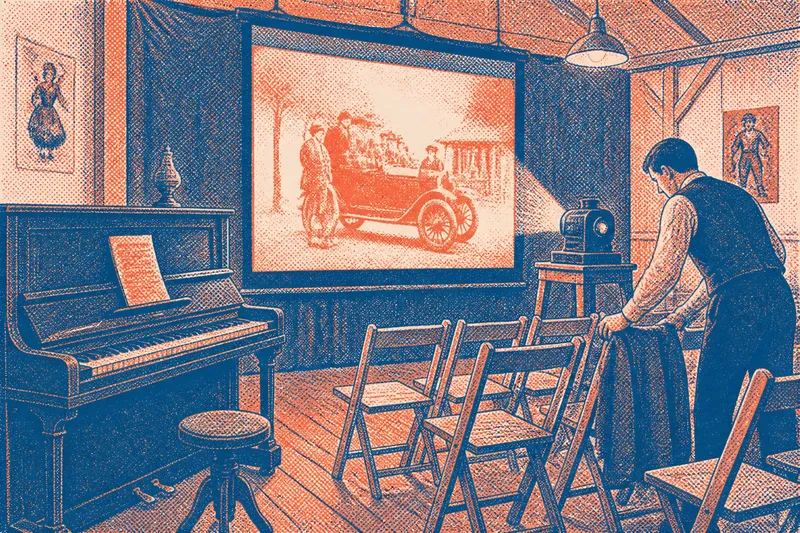
A piano waits beside a screen in a rented hall while someone is still folding a coat over a chair. For a traveling film show, the room could be a town hall, a fairground structure, or another venue already used for public entertainment. The changing cinema visit took different forms across places and periods; there was no single route from temporary show to permanent theater.
Moving pictures entered existing entertainment circuits before purpose-built cinemas became widespread. Traveling exhibitors, music halls, and dedicated theaters could operate at the same time, and their programs differed. The room matters here not as a lesson in audience manners, but as evidence of how film was presented: as a novelty, a variety act, or the main reason for attending.
Traveling exhibitors adapted film shows to borrowed rooms
A traveling exhibitor brought equipment to a venue that was not necessarily designed for film. A hall’s windows, seating, sightlines, and available space for projection all affected what could be arranged. Temporary curtains or a screen might help, but the building retained the limits of its original use.
These conditions varied. A show in a fairground booth was not the same kind of occasion as a film inserted into a music-hall bill. In some settings, a visitor could encounter moving pictures as one attraction among several; elsewhere, the film show itself could be the main event. Local arrangements and the program determine which description fits.
When an account describes a film as part of a larger bill, look for the neighboring acts and the venue. Those details help distinguish a film-centered screening from one element in a broader entertainment.
Mixed programs placed films beside live performance
In music halls and variety theaters, films could share an evening with songs, comedy, or other acts. A short film might serve as a novelty or a change of pace rather than the sole reason for attending. Live music or spoken commentary could accompany the images, depending on the venue and presentation.
That format gave the program a rhythm made of different kinds of performance. The film’s place in the bill mattered: an audience arriving for a variety show might meet it within an established evening of live entertainment, while a traveling film show could make projection the central attraction. Neither arrangement describes every early screening.
Say a traveling exhibitor rents a community hall that is also used for dances. The exhibitor hangs a screen, positions the projector to clear the seated audience, and arranges for a pianist to accompany the film. The expected result is a screening shaped by both moving pictures and a familiar local venue; it is not evidence that all early screenings used the same setup.
When reading a program or description, note whether it names a lecturer, musicians, or other acts. Their presence can explain how a film fitted into that particular event.
Purpose-built cinemas gave film a dedicated venue
Dedicated cinemas changed the physical setting of exhibition. A permanent auditorium could be arranged around the screen, with fixed seating and a projection area intended for regular use. Some venues were modest storefront theaters; others were elaborate picture palaces designed to make attendance feel ceremonial.
“Picture palace” usually refers to an ornate cinema, not to every permanent movie theater. The term can evoke grand architecture, but neighborhood cinemas were often simpler. Both differed from a one-off screening in a borrowed room because film exhibition was built into the venue’s intended use.
Permanent theaters did not immediately abandon mixed programs. Depending on the place and period, a screening might include short films, newsreels, cartoons, or other material alongside a feature. The change lay in having a venue organized for recurring film exhibition, not in every evening becoming a feature alone.
How can you tell what kind of screening a source describes?
Was film the main attraction or part of a variety bill?
Look for references to other acts, music, or a sequence of attractions. If they appear, the film may have been one part of a wider program; if the source centers on the film show, treat that as a distinct possibility rather than assuming a mixed bill.
What does the venue tell you about the event?
A town hall, fairground booth, music hall, or dedicated cinema points to different arrangements, but the building name alone cannot settle how a screening worked. Read it alongside details about the program, seating, and projection.
Does a permanent cinema mean the program contained only a feature?
No. A dedicated theater could show a mixed program, and formats varied by venue and period. Distinguish the building’s regular purpose from the contents of a particular screening.
What can a picture palace tell you?
The term suggests an ornate cinema intended to make film attendance a special occasion. It does not, by itself, tell you what films or accompanying acts appeared on a specific night.
Exhibition history depends on the local record
The terms “traveling show,” “variety program,” and “picture palace” describe broad forms, not a universal sequence. Their dates and meanings depend on local exhibition history. A source that names a venue, lists a program, or describes the projection setup gives firmer ground than a general claim about what audiences everywhere did.
The changing cinema visit is therefore best understood through specific evidence: where the screening took place, what appeared on the bill, and whether the space was temporary or dedicated to film. Those details keep a broad history from turning into a tidy story of one format simply replacing another.
When a historical account leaves the venue or program unclear, keep the conclusion modest. That uncertainty is useful: it marks the difference between what the source says and what a reader might otherwise be tempted to fill in.